Mmmm. My Swedish friend Sanna helped us make these – yes, the ones in the picture! Read more about my cooking adventures under "Cooking."
Cairo, Egypt.
My family lived in Cairo for three years. I was in college, so my time consisted of 2-3 month chunks (got to love those long university vacations). Click to read about my Egyptian adventures
Strandvägen, Stockholm, Sweden.
My home for a year and a half. Beautiful, clean, and cold. You can read about my time in Sweden under "Other Places."
Umbrellas in Seoul
My first weekend in Korea was a rainy one. Vendors on the street sold cute umbrellas for a few thousand won (a few dollars), and I quickly joined the masses in purchasing one. Click here to read about the rest of my weekend.
Northampton, MA
I'm so excited to study at Smith College for a year.
The first time I heard there would be a three day GEPIK teacher's orientation, I had four main questions:
1) Would I learn anything useful?
2) Why were they training me two months after I started teaching?
3) Would this be an opportunity to meet people?
4) Would the food be good?
I was pleasantly surprised by the answers.
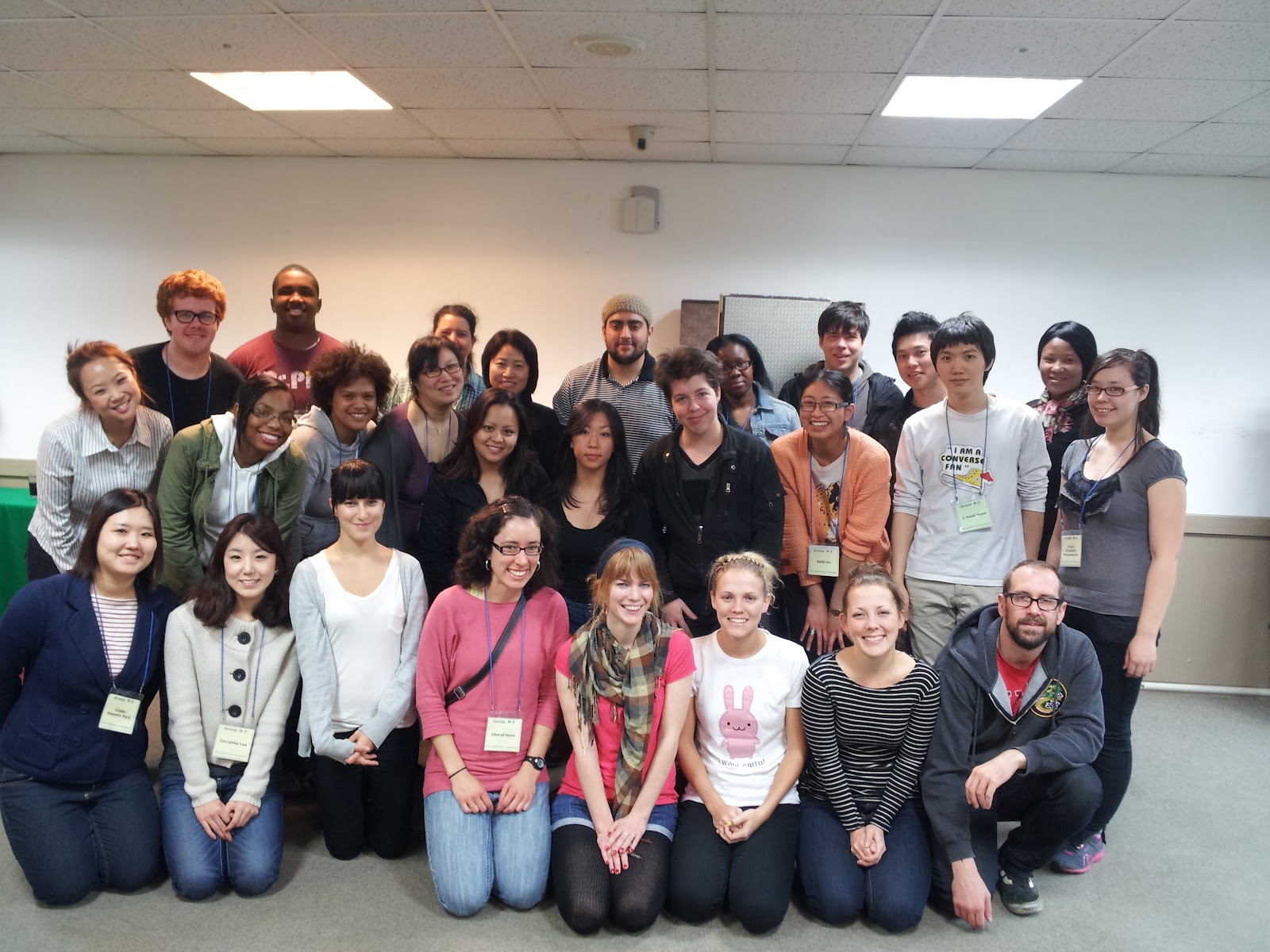
Our GEPIK training group (B3)
An Overview
Orientation was three days and two nights. It consisted of 10 mandatory sessions, two optional sessions, and open evenings. For some of the sessions we were in large auditoriums with the entire group of GEPIK elementary teachers, and for some of the sessions we were split into smaller regional groups (of about 20).
Did I learn anything useful?
Yes. There were sessions covering classroom management, team-teaching, material integration, multimedia usage, and more. There were funny lectures – one speaker told us to invest in a microphone for our classrooms to assert our godhood, informative lectures – I learned some great classroom attention grabbing techniques, and, yes, boring lectures – nobody could figure out why, as Elementary teachers, we needed all the details of the NEAT English test.
I'm particularly grateful for some of the websites and various classroom game ideas that were shared in the sessions.
The timing of the orientation
Even though I had already been teaching two months, I still learned some useful classroom management stuff, and Korean culture/life information. I imagine it would have been an overwhelming amount of information if I had received it my first week here. Doing orientation a bit after my arrival helped me to visualize some of the tips the speakers were giving. Still, if it had been a little bit sooner, it would probably have been more relevant, as at least 40% of the information was already familiar to me.
Socialization
I was actually surprised at what a diverse group we were. A multitude of ages, nationalities, ethnicities, and backgrounds were present, which made for some interesting discussions and well represented the variety of English speakers sprinkled across the globe. Because our groups were divided by region, we were able to get to know people in our areas a little bit better. At night, we bonded over belting cheesy noraebong songs (I pretty much filled my lifetime's quota of Bohemian Rhapsody) and playing pool/ping pong/monopoly.
Meals
The food was pretty decent – everything was buffet style – and three free meals a day (in a non-prison setting) is always a plus. Our first night was a carb-fest of french fries, spaghetti, and rolls (among other dishes). Breakfasts were basic, and included options of rice, cereal, and kimchi. I think all the meals had vegetarian options, but even if those were limited, there was a grocery store at the resort.
Overall
The GEPIK orientation was an enjoyable three day break from teaching. It was also a useful one; I've integrated some of the classroom tips and used some of the sites/material that were suggested in different sessions. I thought the GEPIK coordinators did a great job at preparing lectures that were both broad and specific enough to meet the needs of a diverse group of people. In one of the sessions, I learned that if you don't swipe your card at the end of a bus ride, the next bus charges you double. If nothing else, I'm glad I went to the GEPIK orientation for that bit of knowledge – it's saved me around 60,000 won a month.
Music is a key component of ESL teaching – or any teaching for that matter. Sticking a tune onto information is a terrific memory aid, and I still remember song lyrics I learned in 2nd grade. About a year and a half ago, I discovered The Beatles are the ultimate pop band for teaching English. I'm not sure what it says about a band that a vast number of their song lyrics are ESL-friendly, but I've always been a huge Beatles fan, so I like to think of it as beautiful, universal simplicity.
Check out the following ESL Beatles lyrics:
You say yes, I say no, You say stop, and I say go go go. Oh no. I don't know why you say goodbye, I say hello. Hello, hello.
And
Love, love me do. You know I love you. I'll always be true. So please love me do.
These songs are just asking to have a few fake sign language gestures slapped on and explained to low level English speakers.
They come up with some weird poses
**
Our sixth grade classes are terrifying, with unnaturally high percentages of ADHD and English haters (different than English apatheticers). However, SH and I are slowly starting to understand the personality of each class. 6-1 likes busywork and translating. They aren't big on games. 6-3 likes drawing and singing; they aren't big on writing. 6-2 is...currently a lost cause.
So on Friday we had 6-3 draw pictures to decorate lyrics to a song about calling someone. It's in Korean and English, and includes most of the key phrases from Unit 6. Here's the video (the freeze frames are not glitches, I just didn't take enough time to make them look cool):
Sexy Korean men...was not on my list of reasons for moving to Korea. Not that I didn't find Korean men attractive; I just already happened to be in a relationship. So, in fact, the man situation in my life was actually working against my move. But I'm getting ahead of myself.
Sometime in 2010 I realized that job hunting in California without a car as a fresh liberal arts college grad was not my ticket to a successful career. (On a related note, my plan to take Hollywood by storm through never finding an agent or going to an audition was not my ticket to fame and glory.)
I was also getting antsy. As in, location antsy. As in, I no longer desired to live in America. So I sat in my room playing bellydancing music and reminiscing about my childhood. I became overly enthusiastic about meeting Middle Eastern shop owners, and paid frequent visits to my fellow TCK friend where we cooked Ethiopian food and reminisced about being evacuated from civil wars and fires. (OK, there was only one civil war, and the fire was in California. Still.)
The antsy thing thing happens to me every few years and I blame it on my childhood. And also my personality. Basically on anything that allows me to pass on the responsibility for my psychological demerits.
Anyways, my original post-graduate plan had been to get a job in a writing field. Or possibly join the Peace Corps. Grad school also sounded like a good idea - maybe a bit of international relations to ease an entrance into NGO or State Department work. Grad school also sounded good because I'm an excellent test taker. (It's probably my strongest skill. So, if I'm going by pure skillset, I should get into the perpetual student field of academia.)
I'm not sure when Korea came up in a list of life possibilities, but it was hardly a surprising idea – I had a college friend who was currently teaching ESL in Korea, and I was also interested in the Korean culture. L.A. has a strong Korean-American community, I had a Korean-American roommate (who was and is a superstar), and I was working at a tutoring center which was basically an Americanized hagwon filled with Asian-American students.
Teaching in Korea is an attractive prospect to recent college grads for quite a few reasons.
1) It's a guaranteed full time job in an otherwise questionable economy. 2) It pays pretty well, especially when perks are taken into consideration - Free roundtrip airfare, free housing, low/no taxes, subsidized healthcare. 3) It's an opportunity to travel and live overseas. 4) It's a better resume filler than the part-time/waitressing work that many grads do while looking for a job. 5) It's fun. (Subjective, yes.) You get to hang out with kids, make international friends, eat weird food, and shake your world up.
My third graders.
So, with these reasons in mind, two of my roommates and I started discussing the possibility of teaching ESL in Korea. (These roommates also happened to be my best friends, which is a potentially wondrous and disastrous thing – mixing friendship with rooming – but that's for another post that I'll never write.)
I moved to Sweden. Roommate #1 moved to DC to work on the Hill, and roommate #2 got a full time job and engaged. They both had decided against the idea (in favor of becoming adults), but it still sounded attractive to me, especially when I realized that Sweden involved nine months of icy darkness. So I convinced my newly minted communications grad brother (if ever a major needs a job, it's communications), to join me, and he and his then girlfriend began the application process with me.
He is now teaching with Americorps, but his (ex) girlfriend did make it over and is living in Busan.
Her blog title is much better than mine.
And that's my story. My reasons are pretty typical - a love of traveling, an enjoyment of working with kids, a desire to save money while thinking about my next plans, and an interest in Korea.
I would definitely say that if you don't like kids or are pretty inflexible, teaching ESL here isn't the best idea for you. OK, and no-one is going to describe themselves as inflexible, so let me put it like this: if the idea of having work/classes/meetings constantly changed on you at the last minute makes you feel sick to your stomach, Korea isn't for you. Really.
Also, if you have a serious bf/gf, go the Hardy Boys route and knock them out with chloroform and take them with you. Long Distance sucks.
(No, Frank and Joe never chloroformed anyone, but everybody they came across did. I knew that word at a very young age. Thanks Franklin Dixon/ghost writer.)
The time has come for me to describe a typical day in my life – the life of a public school ESL teacher in Korea. Specifically, a GEPIK teacher. GEPIK stands for Gyeonggi English Program in Korea, and it consists of the public schools in the Gyeonggi-do province – the province surrounding Seoul, South Korea. There are many reasons that I chose GEPIK over a different public or private position, and I'll discuss them in another post.
For now I will outline a typical Thursday. It's my busiest day, so you'll be getting an idea of some of the extra duties I have besides teaching.
Warning: this post is for people interested in the reality of teaching public school in South Korea. If you're already teaching here, or aren't interested in doing so, this will be pretty boring.
A Day in the Life of a GEPIK Teacher
My alarm first rings at 6:30 a.m. I hit the nine minute snooze several times (no idea how to change the time on that), and eventually acknowledge the reality of existence at 7:00. Acknowledging existence = opening eyes and picking up laptop to check mail, news stories, etc.
Oh wait, you didn't want a play by play of my morning routine? Fine.
My classes start at 9:00, which means I'm required to be at school at 8:30, and, as I've a half hour commute, I leave my apartment around 7:40 to catch one of the two buses that go to my school. I think there's a bus schedule, but I don't know how to access it, and the buses seem to come at different times every morning, so I make sure to go out early enough to catch one by 8:00.
When I arrive at school, I change into my school slippers. Every teacher has a pair of school shoes that they keep in a locker at school. Students also take their outdoor shoes off and attend classes in socks.
Before class I scan the day's lesson plans ( provided with the curriculum, but sometimes we modify them) and discuss with my co-teacher how we'll conduct the class. She generally leads the 3rd and 4th graders because their English levels are so low: it's necessary to explain games/new vocab, etc. in Korean.
On Thursdays I arrive a little earlier because Thursday (and Tuesday) is a Broadcast English morning. This means that my face adorns the screens of all of the classrooms from 8:30-8:40. Don't freak out if you're considering doing public teaching – many schools don't do a morning English broadcast. Also, it's really relaxed and the camera isn't on me most of the time:
Morning English Broadcast
Morning English Broadcast consists of me reading a children's book on camera to the students. I go into a special soundproof studio (adjoining the teacher's lounge) and stand behind a podium across from a small video camera on a tripod manned by a student. Behind me on the wall "Morning English" is spelled out in happy bright letters. Across from me is another podium with three microphones for the three students who assist me in Morning English.
The children's books that we are going through all have accompanying music videos (the text becomes the lyrics and the images are scans of the book pages). The music video plays on TV screens across the school, and when it finishes, I start my lesson.
I greet the students, ask how they are and how the weather is, and respond to the same questions in a super cheerful I'msohappytosharemylanguage voice. I then pick up the book – we're currently doing "The Animal Boogie" and exclaim over the pretty illustrations. "Wow" I say. "Look at the juuuunglllle." (My co-teacher instructed me to be very enthusiastic and say "wow" as many times as possible.)
I teach the children some new vocabulary from today's page (we read one new page per broadcast), and my three helpers listen and repeat the new words. Unfortunately, because it's a children's book, some of the words are borderline nonsensical – thankfully no Dr. Seuss yet (though I have had to "translate" his books for my students back in Sweden). Don't hate on me – I adore Dr. Seuss. It's just that he, and many children's book authors, did not consider the confusing implications their words might have in the world of ESL. Explaining English words is difficult enough without having to define "thneeds" and "truffluas."
So, for morning English, I get to slooowly say words for my helpers to sloooowly repeat.
I teach 23 sessions of 40 minutes per week, from 3rd-6th grade. Each grade is divided into two or three classes: 6-1, 6-2, 6-3, etc. This means that each lesson plan is repeated two or three times to the different classes. On Thursday I have class from 9:00-9:40, 9:50-10:30, 10:40-11:20, 11:30-12:10, 1:00-1:40, and 1:50-2:30. It's the only day I have six classes, and one of them is a special after school English class with advanced students. I get paid extra for this class because the GEPIK contract signs a teacher up for a 22 class work load. (I have the option of getting paid for this class or for using it towards vacation - 8 hours = 1 day of vacation.)
The curriculum our school uses consists of textbooks, teacher guides, CDs and a workbook with additional excercises.
A typical lesson
Each class begins with a song (which I shared with you on this post) to get the students seated and focused. After the song, I ask the students: "What can you do?" and they shout back "I can study English!" (Yes, some good ol' repetition and phrase memorization.)
After the song, I do greetings: "How's it going?" (useful phrase, eh) "Who's TIRED?" (make sleepy face, hand pillow), "Who's HUNGRY?" (point at stomach) – the kids are always hungry – "Who's ANGRY?" (stomp foot), etc. And then we get to the weather.
Every single day in April my kids stubbornly (and loudly) insisted that the weather was "Hot! Very Very Hot!" (with accompanying tugging at shirt and fanning face motions). I, equally stubbornly and loudly insisted that it was COOL. Because it was. Our average morning temperatures in April were under 68F (20C) and I would shiver in my jacket at the bus station, only to end up, an hour later, in a heated debate over the warmth of the weather. To be fair to my kids, the afternoons often warmed up – but that wasn't the question. I would point at their jackets asking why they needed them in hot weather, which got confused looks – not because of my logic but because of my using unscripted English words. Sigh.
After the greetings, westart the lesson. The textbooks we use are laid out in chapters, and each chapter has a theme and set of key expressions/words that the students should know after completing the chapter. The chapters are split into sections (called periods) which focus on a different aspect of learning English: speaking, reading/writing, listening, etc.
So: currently we are doing Lesson (chapter) 4 in 6th grade. This chapter is titled "When is your birthday" and revolves around dialogues about when events will be taking place. For example:
"When is your birthday?"
"It's April 5th."
"What will you do?"
"I will have a cookie party/pizza party/barbecue party."
"When is Earth Day?"
"It's April 22nd."
"What will you do?"
"We'll pick up cans and bottles and have an Earth Day parade."
The students will be taught the questions and responses, and some accompanying vocabulary to play with. In this unit, some of the new vocabulary is: bottle, parade, people, office, and the months of the year.
I sometimes take issue with the phrasing of things in our books, because I don't know anyone who would say "I will have a cookie party" instead of "I'm going to have some friends over, and we'll make some cookies." I've actually never the term "cookie party" used. Or "Barbecue party" for that matter. We also had a chapter where we taught the expression "I'm in the 6th grade" instead of "I'm in 6th grade." (Or even more realistically, when someone asks what grade you're in: "6th.")
Our class period consists of watching a few of the CD dialogues on the big screen TV at the front of the class (connected to a computer), and asking the students comprehension questions about what the characters are doing/saying. The students also listen to and repeat the dialogues. Often there are interactive questions on the CD that the students answer in their workbooks. We then go over the answers together.
There are usually activities in the workbooks for the students to complete depending on the focus of the period. If the focus is reading/writing, the students will be tracing or writing sentences/words in their books. If the focus is speaking, students will create dialogues together based on picture prompts in their books.
Almost every period has a subject/vocabulary-themed game suggested in the Teacher's Guide at the end. We change many of these games because we know the types of activities our kids would prefer.
During the lesson, my co-teacher and I tag teach. She leads one section of the period while I a) get the next one ready b) walk around the classroom and make sure the kids are listening to her, or c) assist her.
I lead the majority of the sections in 5th and 6th grade, and she leads the majority of 3rd and 4th grade.
Lunch
Our lunch break is 50 minutes, and I eat with the rest of the school in the cafeteria. You have an option to bring your own lunches, which I would only recommend if you're a picky eater or have special dietary restrictions. Even if you're a picky eater, you should see if you can try a lunch or two to see if you like it.
Reasons I eat in the cafeteria:
1) It's cheap. The food is subsidized by the government, and I pay about 2 dollars per lunch.
2) It's social. All of the teachers and students eat in the cafeteria, and it's often the only contact I have with the other teachers.
3) It's filling and decent food. The lunch trays have five food sections on them, and there's always something that I like. Meals always include kimchi, a ton of rice, a bowl of soup, some sort of vegetable, and usually some sort of meat. Everything is eaten with chopsticsks and a spoon.
Sometimes there are some funky looking things on my tray which I don't try, (I am averse to the idea of eating anything with suction cups on it), but quite often there is a pleasant surprise - fresh fruit, yogurt, etc.
Afternoon classes
Two days a week I have no classes after lunch, two days a week I have one class after lunch, and on Thursdays I have two. My second one is a special class which I get to design and implement by myself. I really like this class because I get full control over the content and can throw in things that I don't have time for in my other classes.
In my special class, we do a lottery every two weeks where I pick out the name of two students from a bag, and they win a small prize (pencil, candy, etc.). If students have three strikes against them, their names aren't in the drawing.
My special classes are usually grammar and subject themed lessons with funny youtube clips, games, and pop songs thrown in. By the end of each lesson my students should have learned five new vocabulary words.
I've heard of English teachers doing a variety of extra classes including teaching a class of other teachers at the school, teaching a creative writing class, teaching a song class, theatre class, or a sports class.
The front of my school (view from classroom window).
The rest of my day
I usually have a few hours after class to prepare future lesson plans, etc. Only a tiny fraction of this extra time is needed for school-related stuff, and I'm often online reading articles and books, or blogging (and yes, checking Facebook). Sometimes the 3rd grade teacher in the classroom next to us has a lot of food from the students' parents, and she invites us over to eat and gossip. Or, in my case, eat and watch them gossip. I never take work home.
My bus drops me off around five, and I finish my evening with normal activities that aren't country/job specific - grocery shopping, dinner making, TV watching, writing, reading, socializing, etc.
Grocery shopping can be pricey here, depending on whether you to keep vegetables and fruits in your diet. These tend to run higher than they did in the States, and they occasionally climb above Swedish prices too (which is just scary.) Meat can also be quite expensive, as is cheese and nuts. Nothing is too crazy though, except the occasional foreign item (one avocado will set you back five dollars), Skippys peanut butter hits six dollars (in certain locations). A liter of milk averages about $2.10.
Making dinner is a little depressing because I don't have an oven. And guess what? If you're coming to teach English in Korea, you won't have an oven either! (Unless you buy it yourself or get extremely lucky). Also, the food you will be working with are different here, unless you're planning on funding the beach houses of the owners of the foreign food stores in Seoul. Foreign food store = place to spend money when you're having a everythingisweirdhereandijustwantsomemacandcheeseinaboxtoremindmeofhome moment. Not the best place for general groceries.
A TV came with my apartment, but it doesn't work. I have friends who get some decent international shows though. I prefer to watch TV on my computer regardless.
Socializing in Korea is not too difficult, depending on location. Other native English teachers are in the same boat as you - in Korea for a limited amount of time and looking to make friends. In and around Seoul, there are bars, clubs, restaurants and other forms of nightlife like noraebongs (Korean karaoke rooms). For daytime, there are many clubs - sports, hiking, cultural, Korean classes, writing, book clubs, taekwondo, etc - you can join which can be found on meetup.com, facebook, and by asking around.
Reading is something I do on my kindle. There are English bookstores in Seoul, but as I live an hour+ away, it's much more convenient to download books. Also, they weigh a lot and you probably won't reread most of them. I made a very hesitant transition, but am extremely glad that I did.
**
That's about it for a day in the life of a public school English teacher in Korea. This post is for my detail starved mother. :)


 9:12 PM
 Sho
Sho



.jpg)


